
The Christmas show at Leeds Playhouse has always been one of the highlights of my theatregoing year, there have been any number of corkers, each treated with respect and presented in spectacular fashion. Sadly, this year’s effort is a let down, the annoying thing is that it needn’t have been. In my book, if you are going to ‘do’ an adult literary classic such as this, rather than a family friendly story, there are two options; you either stick to the source material, or, if you inexplicably decide to transform it into a Christmas Special, you have to go the full Muppet.
Here we have Dickens’ masterpiece tinkered with so that it loses its impact as a powerful polemic highlighting the plight of the working class in Victorian Britain, but doesn’t make it as a family show either. The irony is that it was the striving for inclusivity which undermined it. I have absolutely nothing against the involvement of actors from diverse walks of life taking part in works in which it is appropriate, in fact I salute Leeds Playhouse for facilitating this in their various initiatives, but this is not one of those.
The problem, as I see it, is that the action is still rooted in the 19th century when attitudes were so much different from what they are today. I never thought I would write this, but, had it been moved to 2025, there would have been more scope for inclusivity to make an impact. In fact, although ostensibly Victorian, there were several things only relevant to the 20th and 21st centuries, again shattering the atmosphere. I doubt that Gladstone and Disraeli celebrated election victory by giving their party members double, low ten, hand slaps.
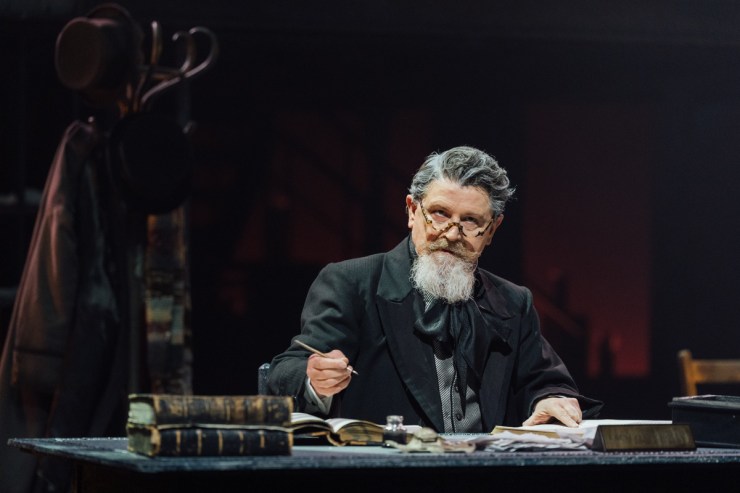
For those who are unfamiliar with the work – I have readers all over the world – the story centres around Ebeneezer Scrooge, a businessman who is obsessed with making money, and keeping it. The firm which he runs is called Scrooge and Marley, the latter being his partner who died on Christmas Eve, and the action begins in the office on the seventh anniversary of his death. Bob Cratchit, his overworked and underpaid clerk, begs Scrooge for Christmas Day off so that he can spend it with his wife and young son, Tiny Tim, who is suffering from a respiratory disease which will prove imminently fatal, should he not be able to raise the money to pay for treatment. Reluctantly Scrooge agrees but insists that he is in the office earlier than normal on 26th December in order to make up for lost time. Scrooge’s nephew, Fred, arrives with the annual invitation for his uncle to attend his house for Christmas dinner, which, as usual, Scrooge declines. He then sends away two men who call to ask for donations for the poor. On completing his day’s work he goes home alone.
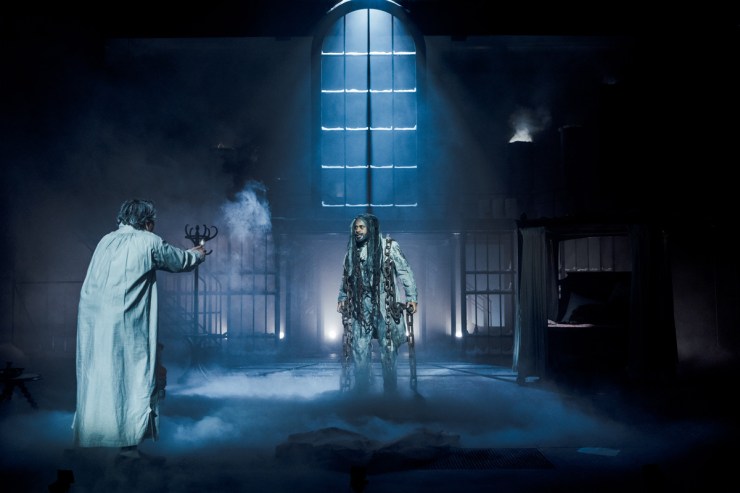
During the night he is visited by the ghost of his old partner, Jacob Marley, who is bound by heavy chains and money boxes containing the proceeds he has amassed over the years. He tells Scrooge that he has a chance to escape the same fate and that he will be visited by three spirits whose words he must heed or be doomed to carry much heavier burdens through eternity.
The first spectre is the Ghost of Christmas Past which transports him back to his boyhood when he was at boarding school, lonely and abandoned by his parents. His only relationship was with his sister Fran, the now late mother of Fred, until he was invited to the home of Mr Fezziwig, his first employer who treated him as a son. Scrooge then became engaged to Belle but she dumped him when she realised that he thought more of money than he did of her. The ghost then took him to visit Belle and her husband and family on the night of Marley’s death but he demanded to be taken home when he heard the way in which someone described him.
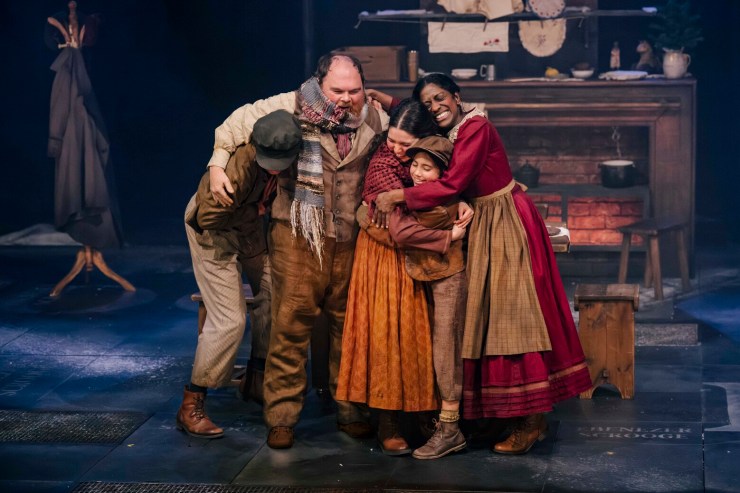
Stephen Collins and Nadia Nadarajah as Mr and Mrs Cratchit and family
Later in the night Scrooge was visited by the Ghost of Christmas Present, who took him to a market which was buzzing with shoppers having a good time preparing for Christmas Dinner. They then went on to Fred’s party, later visiting Bob Cratchit’s house where their meal was very sparse. He is introduced to Tiny Tim and the spirit tells Scrooge that the boy will die unless things change.
He then sees the Ghost of Christmas Yet To Come, who shows him a Christmas Day in the future where the funeral of a man who everyone disliked is taking place, the only mourners are a couple of local businessmen, solely present as there is a free lunch. His cleaner and the undertaker steal the deceased’s clothes and sell them. When Scrooge asks if there is anyone who felt emotion over the death, he is shown a couple who are happy now that their debt to the man can be delayed long enough for them to get their finances in order. Scrooge then asks the spectre to show him someone displaying tenderness at a death He is taken to Bob Cratchit’s house where they are mourning the death of Tiny Tim. Scrooge and the Ghost end up in a cemetery where there is an overgrown gravestone with his name on it. This prompts him to vow to change his ways.
When Scrooge awakes on Christmas morning he makes a large donation to the charities he shunned and anonymously sends a large turkey to the Cratchits. He goes on to Fred’s party and has a good time. The following day he gives Cratchit a pay rise and takes Tiny Tim under his wing. From that point he treats everyone with kindness and generosity.
Now that is out of the way, let me explain what I had problems with. The main one is that this was written as a ghost story aimed at scaring people into behaving better toward each other, not a comedy or a piece of light reading, in fact, it is extremely dark. The whole point is that Scrooge is a really nasty piece of work with no redeeming features whatsoever. Bob Cratchit, played superbly by Stephen Collins, and his wife, the equally talented, Nadia Nadarajah, are both deaf actors, which absolutely shatters this image as it makes him look quite a benevolent employer. Being deaf in the 19th century would have all but precluded Bob Cratchit from anything but menial work as, although there were some charity schools, which Scrooge obviously didn’t believe in, it wasn’t until 1855 (12 years after the book was written) that free education was available for children under 14 who were ‘deaf, dumb, blind, lunatics or criminals’, and 1870 before became a requirement.
Although not time-shifted to the present day, the programme tells us it had been moved from London to be set ‘firmly in Leeds’ and Scrooge turned into a ‘late Victorian Yorkshire mill owner,’ so nudged on a couple of decades after the book was written. Was this as a condescending gesture to the audience, or maybe to cash in on the ‘racial’ stereotype of we Yorkshire folk being tight with our brass? Whatever, it certainly wasn’t in tribute to Dickens, who hated Leeds, famously describing the station as ‘a rotten little platform’ and the city as one ‘I particularly detest as an odious place’ and ‘one of the dirtiest places’ he had been.
Despite the heavy industry, Leeds must have been a very quiet place in ‘late Victorian’ times. because, on the hour, you could hear the chimes of Big Ben, 200 miles away.
As previously alluded to, there were black actors involved, one of whom, Obioma Ugoala, had been equipped with a huge wig, coiffed into dreadlocks, in order to play – you guessed it – Marley. No woman, no cry, it is only another liberty being taken. Had it not been a pretty feeble pun – I should talk! – dreadlocks are a feature of the Rastafarian religion which wasn’t originated until the 1930s. Also, according to the 1921 census, there were only five residents of African origin in Leeds even at that time, (although the number could have been slightly higher) meaning that there may have been more on stage than lived in all of ‘late Victorian’ Leeds. By contrast there were no noticeable Jewish actors in evidence, even though there were 8,000 such residents of the city in 1890.
There are so many other ways in which this production was a huge let down, another one worth a mention was the appearance of a coal miner, complete with modern hard hat, during the singing of the carol Oh Christmas Tree, which shares its tune with the Labour Party (founded in 1900) anthem. Yes, I know that it was a play rather than a documentary, but Dickens’ novella was such a damning account of Victorian life, and written in such a specific genre, it deserved to have been treated with more respect.
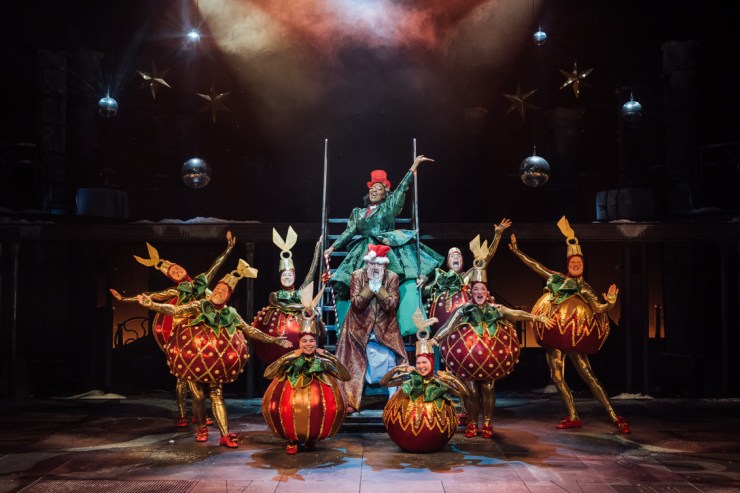
Ironically, the best part of the whole show was a musical number with a troupe of dancing Christmas tree baubles. It was hilarious and brilliantly executed, although hardly in keeping with the gravity of the subject.
I must mention Reece Dinsdale, who, as Scrooge, held the whole thing together, although his Santa style beard was a bit incongruous to his character, and he spent the first five minutes repeating the phrase, bah humbug, in a broad Yorkshire accent. What you might call a case of reckless over-tyking. My pun retaliation.
The set, by Hayley Grindle, who also designed the costumes, was very impressive with the smoking chimneys and an enormous ghost figure, As mentioned, the choreography of the bauble dance, as well as the other set pieces was very well done by Emily Jane Boyle.
I will end by saying how much I have hated writing this piece, I always go to the theatre with the same attitude, as if I had I not been working, namely to have an enjoyable and/or thought-provoking experience. Despite the research I have done in supporting my point, this was neither, it appeared to be a box ticking exercise designed to prove how worthy the production team, Adaptor, Deborah McAndrew and Director, Amy Leach, were, by imposing 2025 values on a 1843 work, and destroying it in the process. They couldn’t even get the famous final line right, when Tiny Tim should have said ‘God bless us, every one!’ We got ‘God Bless us, everybody!’ I rest my case, Your Honour.
I presume that next year’s Christmas show is already in the planning stage, I just hope it is a work more suitable for the occasion. Should you wish to see something a lot more family friendly at Leeds Playhouse this Christmas, give The Stick Man a try, and for inclusivity it must be Emporium Curioso 2 they are both done with respect and a total lack of pretension.
For details of all Leeds Playhouse productions, please go to https://www.leedsplayhouse.org.uk/whats-on/
Photographs by Helen Murray

